
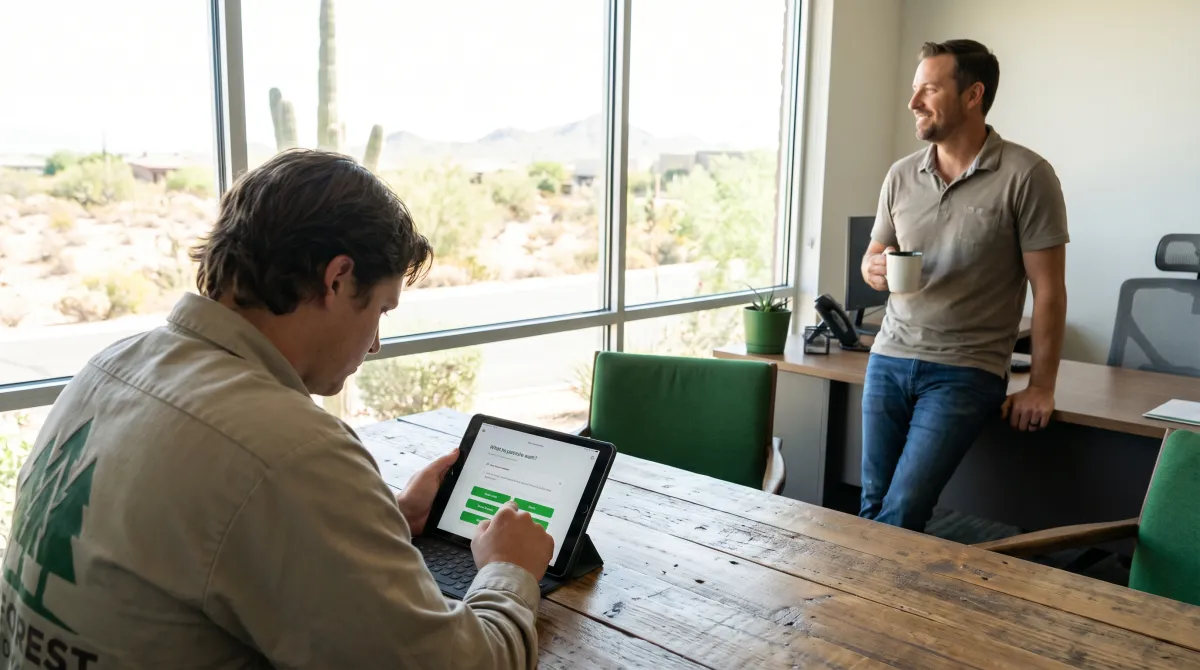
TL;DR A landscaping company with 12 seasonal employees was burning 4–6 hours onboarding every new hire: safety protocols, equipment walkthroughs, client communication rules, scheduling. We took their existing documents, cleaned them up, and turned them into an AI assistant new hires can actually ask questions. Human onboarding time dropped to about one hour per person.
The problem: a Drive folder nobody opened
The owner had done the right thing, technically. He'd written stuff down. There was a Google Drive folder with a safety PDF, a half-finished equipment guide, a "client standards" doc from three years ago, and a scheduling explainer that contradicted the scheduling explainer next to it.
Nobody read any of it.
So every spring, when the crew doubled for the season, the same thing happened. A new hire would corner a manager in the equipment yard and ask how to handle a client who's upset about a missed mow. Or when to call in sick and who to call. Or how to log their hours so they actually get paid right.
Good questions. The same good questions, every season, from every new person, to a manager who has a route to run.
The knowledge existed. It just lived in three people's heads and one folder nobody trusted. New hires didn't know what they didn't know, and the documents were too scattered to be worth the search.
What we built
The fix sounds boring, and that's the point. We didn't build a custom app. We built a place where the answers live and a way to ask for them in plain English.
Three steps.
First, we fixed the documents. This was the real work. We pulled everything out of the Drive folder, threw out the contradictions, and rewrote the gaps. The two scheduling docs became one. The equipment guide got finished. We sat with the owner and one senior crew lead for an afternoon and wrote down the answers that only existed in conversation. By the end, there was a single knowledge base that was actually correct.
Then we connected it to a RAG-based Q&A tool. RAG just means the AI answers from your documents instead of guessing from the open internet. A new hire types "what do I do if a client isn't home and the gate's locked?" and gets the company's real answer, pulled from the company's real policy, not a generic one an AI invented. It only knows what's in the knowledge base. That's deliberate.
We used an off-the-shelf tool for this. No custom development, no dev team, monthly cost in the range of a couple of equipment rentals. For a 12-person shop, paying someone to build something custom would have been a waste.
Last, the managers recorded short phone videos answering the 10 questions they were sick of hearing. How to start the zero-turn that always floods. How to load the trailer so nothing shifts. Thirty to ninety seconds each. We linked those into the relevant answers, so when a new hire asks about the mower, they get the policy and a clip of their boss showing them.
The results
First-week interruptions to managers dropped sharply. The new hires stopped saving up questions for a person and just asked the tool, often before they'd have thought to bother anyone.
The owner ran his own numbers, which I trust more than mine. He'd been spending 4–6 hours of paid manager time per seasonal hire. After the change, the human part of onboarding ran about an hour: a real conversation, a yard tour, a handshake. The tool covered the rest. He put the savings north of 60% per hire, and with a dozen seasonal hires, that adds up to a chunk of a manager's spring.
The softer result mattered more to him. New people felt less dumb. Asking a screen "what's the dress code" doesn't cost you any pride. Asking the foreman the same thing on day two does. People got self-sufficient faster because the cost of asking dropped to zero.
What actually made it work
Here's the expensive truth: the AI was the easy half. The documents were the hard half.
A RAG assistant can only answer from what you give it. Point one at a messy, contradictory folder and you get a confident tool that gives messy, contradictory answers, the same way a raw chatbot confidently makes things up. Now you've automated your bad documentation, which is worse than no tool at all, because people believe it.
So most of this project wasn't AI work. It was sitting down and writing the answers clearly, once, the way they should have been written years ago. The fact that we were feeding an AI just forced the discipline to finish the job. A lot of small businesses already have 80% of their onboarding written down. The gap is that it's scattered, stale, and unsearchable. Close that gap and the AI layer on top is almost trivial.
If you're considering this, that's the honest order of operations. Fix the knowledge first. Add the assistant second. Anyone selling you the reverse is selling you a demo, not a working system.
Want this for your shop?
If you're re-explaining the same things every hiring season, we can help. We'll audit your existing onboarding materials, tell you honestly what's usable and what needs rewriting, and build something your new hires can actually ask questions. Start with a free audit.