
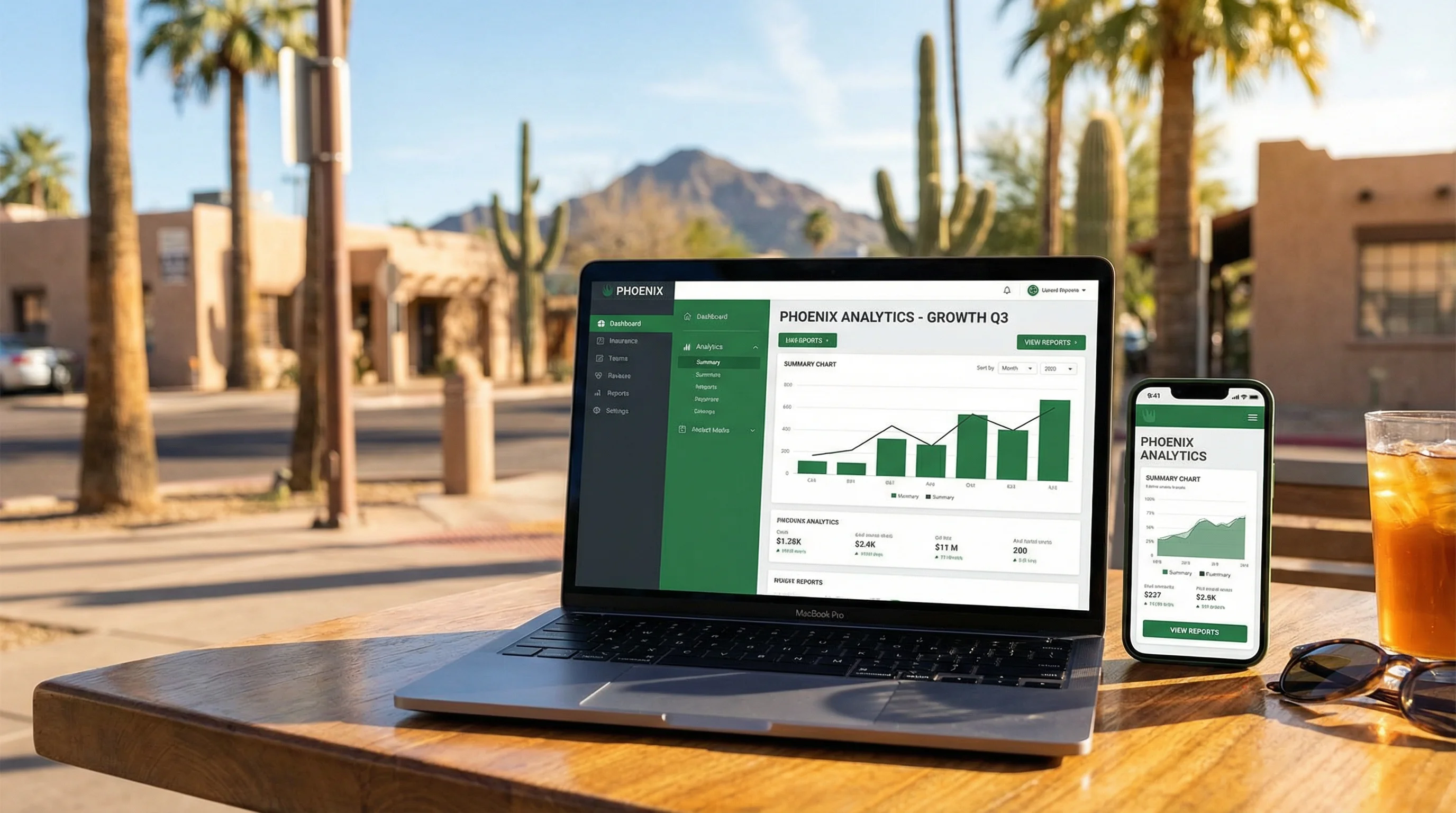
Your AC tech probably called you last week. Or you called them. Either way, somewhere around late February, every Phoenix business owner starts thinking about the same thing: is everything ready before triple digits hit?
Your website deserves that same phone call.
The Pre-Summer Tune-Up Your Website Needs
Phoenix runs on a seasonal cycle that most web advice ignores. National blog posts talk about "holiday traffic" like it's the only spike that matters. But here in the Valley, summer is its own beast. Snowbirds leave, sure. But locals stay home, shop online more, and search for services from their phones while hiding from 115°F afternoons. If your site loads slowly or shows wrong hours, you're losing real money from June through September.
Think of it like your HVAC system. Nobody wants to find out their compressor is shot on the first 110° day. Same logic applies to your website. A quick audit now on load speed, contact info, and mobile usability saves you from discovering problems when customers are actively trying to give you money.
Mobile Speed Isn't a Nice-to-Have in the Valley
Back in 2017, a Google/SOASTA study found that 53% of mobile site visits were abandoned if pages took longer than three seconds to load. That was nine years ago. Expectations have only gotten stricter since then, and research from Portent shows that conversion rates drop roughly 4.4% with each additional second of load time in the first five seconds. People are less patient now, and the standard is higher.
In Phoenix specifically, mobile matters more than in most metros. We're a car city. People search from parking lots, from their cars at Fry's, from the pickup line at school. They're on cellular connections, often with one bar in a concrete parking garage off Camelback. Your site needs to load fast on a mediocre connection in direct sunlight where the screen is already hard to read.
Run your site through Google's PageSpeed Insights right now. Seriously, go there and plug in your URL. You'll get separate scores for mobile and desktop. Most small business sites I audit in the Phoenix area score between 30 and 50 on mobile. PageSpeed Insights calls that "Poor," which means the red zone.
The usual culprits:
- Images that were uploaded straight from a phone camera at 4MB each
- A WordPress theme running 14 plugins you installed in 2021 and forgot about
- No caching headers, so the browser re-downloads everything on every visit
- Third-party scripts from that chatbot widget and review aggregator you tried once
Fixing images alone can cut your load time in half. Convert to WebP format, resize to the actual display dimensions, and use lazy loading so images below the fold don't block the initial render. Free tools like Squoosh.app (a Google Chrome Labs project) handle the conversion right in your browser.
Your Google Business Profile Might Be Lying to Customers
Local search readiness goes beyond your website. When someone in Tempe searches "plumber near me" or "best coffee shop Scottsdale," Google pulls from your Business Profile first. Your actual website might not even show up above the fold. That GBP listing is doing the heavy lifting.
And it's probably wrong.
I can't tell you how many Phoenix businesses I've seen with Thanksgiving hours still posted in March. Or a phone number that rings to an old location. Or a street address that Google has auto-"corrected" to somewhere slightly wrong. One restaurant in Gilbert had their GBP showing "Temporarily Closed" for six months because someone clicked the wrong button during a remodel and never fixed it.
Your GBP checklist for right now:
- Log into your Google Business Profile dashboard and verify your hours are accurate, including summer hours if you adjust them
- Check that your phone number, address, and website URL all match exactly what's on your website (Google cares about this consistency; they call it NAP, for Name, Address, Phone)
- Look at your recent reviews. Anything unanswered from the last 30 days? Reply to it today. Google's local ranking considers how you engage with reviews
- Make sure your business categories are specific. "Restaurant" is too broad. "Mexican Restaurant" or "Breakfast Restaurant" tells Google who to show you to
If you serve specific areas around the Valley, add them. Chandler, Mesa, Gilbert, Scottsdale, Paradise Valley. Each city you list gives Google another reason to show your profile when someone in that area searches.
Uptime Matters Most When It's Hottest
Where is your website actually hosted? If it's on a $4/month shared hosting plan, your site is sharing server resources with hundreds of other sites. When traffic spikes, whether it's yours or someone else's on that same server, performance drops. Sometimes the site just goes down entirely.
We've seen this pattern repeat every summer at Marshland Software. A landscaping company in Mesa runs a Facebook ad for monsoon cleanup services, it gets shared a bunch, and suddenly their $4 hosting plan can't handle 200 simultaneous visitors. Site goes down for two hours during peak interest. That ad spend? Wasted.
If you're not sure what your hosting can handle, it's worth asking your provider before summer. The answer you want to hear involves words like "auto-scaling" and "CDN," not "shared server" and "unlimited bandwidth." If you want a second opinion on your setup, we're happy to take a look. And if your current host is part of the problem, our hosting is a flat $120 a year with the basics already handled and none of the noisy-neighbor nonsense.
The Parking Lot Test
One last thing. Today, before sunset, take your phone outside and pull up your own website. Stand in a parking lot. Try to find your phone number. Try to fill out your contact form. Try to read your services page.
Can you see the text with the sun washing out your screen? Does the page load before you lose patience? Is the tap target for your phone number big enough to hit with a thumb? Can you navigate the menu without accidentally tapping the wrong link?
If any of those answers are no, your customers are having the same experience. And unlike you, they won't try a second time. They'll hit the back button and tap your competitor's listing instead.
Do the parking lot test. Fix what's broken. It's a lot easier to deal with now than in June when you're sprinting back to the AC after thirty seconds outside.
If you'd rather have someone else run through all of this, we do free summer-readiness audits for Phoenix businesses. We'll check your speed, your GBP, your hosting, and the parking lot test, then tell you exactly what to fix and what's fine. No pitch, just a punch list.
And if you're curious whether AI could actually help your business, not just in theory but in your specific workflows, our AI Audit answers that in one week for $750. We map ten of your most-repeated processes and deliver a written breakdown of where AI creates real ROI and where it doesn't.