
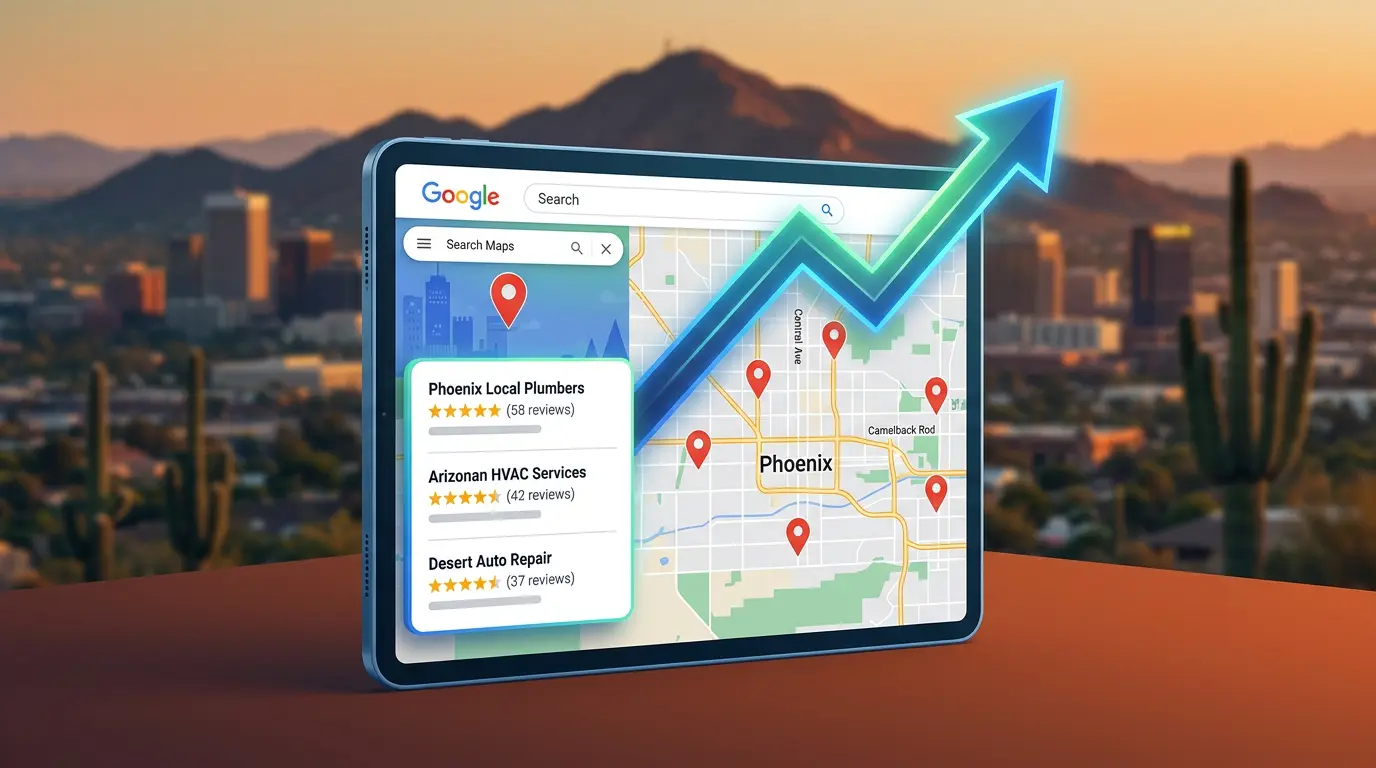
The three spots in Google's Map Pack get most of the clicks. Everybody knows that. But in Phoenix, those three spots are contested by businesses that have been building their SEO presence for years while the Valley kept growing. So what's the play when you're a Tempe plumber competing against companies that hired a dedicated SEO firm back when Gilbert was still mostly farmland?
You go where most of them aren't paying attention.
The Map Pack Isn't the Whole Game
Here's what the data actually shows: somewhere between a third and half of local search clicks go to the Map Pack. The majority go to organic results, directories, and other listings. For a high-intent search like "emergency AC repair Chandler," a well-placed Yelp listing or a page that ranks organically can pull just as much business as the third Map Pack spot.
Chasing those three spots makes sense. But treating them as the only goal leaves real opportunity on the table, especially in a market that's grown this fast.
The smarter move is building the kind of local presence that makes you hard to miss regardless of where the searcher's eye lands.
Local Citations Worth Your Time
A citation is any mention of your business name, address, and phone number online. Google uses citation consistency as a trust signal. The more often your information appears correctly across reputable sites, the more confident Google is that your business is legitimate.
For Arizona service businesses, a few directories carry more weight than others:
- If you're a licensed contractor, your Arizona ROC listing is already an authoritative citation that most out-of-state SEO guides never mention. The Arizona Registrar of Contractors is what your customers check before they hire you, and it's what Google uses to validate you. Make sure your NAP there matches everywhere else exactly.
- Yelp still matters in Phoenix but isn't the force it is in LA or San Francisco. Maintain an active, photo-complete profile and respond to reviews, but don't over-invest here relative to Google.
- BBB accreditation isn't cheap, but the citation itself is free. It shows up in branded searches and Google respects it.
- Phoenix-area suburbs are active on Nextdoor, and it generates genuine referrals for home services. The neighborhood-level targeting is actually useful in a metro where Scottsdale and Glendale homeowners have very different expectations.
- The Greater Phoenix Chamber Business Directory is worth the time. Chamber-backed listings carry credibility signals that generic directories don't, and chambers are also one of the best local link sources in the Valley.
- Niche directories by trade: Houzz for contractors, Healthgrades for medical, Avvo for legal. These are table stakes in your vertical regardless of market.
Apple Maps and Bing Places matter too, but mostly because inconsistent data there can undermine citations you've built elsewhere. Get them right and don't think about them again.
What kills citation value is inconsistency. "123 Main St Suite 4" and "123 Main Street #4" look the same to a human but register as different to a crawler. Pick one format and use it everywhere.
Why Neighborhood Content Wins in a Metro This Size
Greater Phoenix covers roughly 14,600 square miles across Maricopa and Pinal counties. More practically, Maricopa County alone spans about 9,200 square miles. A search for "electrician in Phoenix" is almost meaningless at that scale. People don't think that way. They search for "electrician in Scottsdale" or "licensed electrician Chandler."
This is where most Valley service businesses leave the most opportunity behind.
A dedicated page for each city or neighborhood you actually serve, with content that's actually specific to that place, will rank for searches your homepage never will. The page for Arcadia can mention the older ranch homes and mature citrus trees that make that neighborhood look like nothing else in Phoenix, and the electrical panel upgrades those properties typically need. The page for Queen Creek can mention the newer construction and the first-time homeowners who are still figuring out what maintenance looks like. Specificity is what makes these pages useful, and useful pages rank.
Some cities and neighborhoods worth building out for most Valley service businesses:
- Arcadia, Biltmore, Paradise Valley (high average project values, older housing stock, homeowners who pay for quality)
- Scottsdale, Carefree, Cave Creek (premium positioning, strong search volume, competitive but high-return)
- Chandler, Gilbert, Queen Creek (newer construction, fast-growing, family demographics with specific service needs)
- Tempe and Mesa (established suburbs, diverse demographics, high search volume across most trades)
- Peoria, Glendale, Surprise (West Valley has its own search patterns; don't assume East Valley copy works here)
You don't need to build all of these at once. Start with the cities where you do the most work. Two solid pages beat a dozen thin ones. A focused 600-word page that mentions actual streets, landmarks, and service-specific context will outperform a generic 2,000-word page optimized for "Phoenix" every time.
One addition worth making: show a map on each location page showing your service area. Adding a map helps users confirm you serve their area, which reduces bounce on mobile.
Building a Citation Audit Habit
Citations drift over time. You move offices. You change your phone number. A data aggregator pulls old information and pushes it to fifty directories at once. This is how businesses end up with three different phone numbers floating around the internet, and Google quietly loses confidence in all of them.
The tools that help most:
- Moz Local scans major directories and flags inconsistencies. The paid version pushes corrections automatically. Worth it if you have a complicated citation history or multiple Valley locations.
- For more granular tracking, BrightLocal is the better option. Their Citation Tracker is particularly useful if you want to monitor velocity over time or manage multiple service areas.
- The free version: search your business name in quotes on Google, then search your phone number in quotes. What comes up is often the most revealing audit you'll run all year.
Set a calendar reminder to do a manual audit once a quarter. It takes about 20 minutes and it's the kind of maintenance work that quietly pays off over 12 months.
If you find a directory you can't edit directly, most accept correction requests through a contact form. Yext can handle bulk corrections if you're willing to pay for the convenience. It's particularly useful after a phone number or address change when you need everything updated fast.
Where Marshland Fits In
Citation audits, neighborhood page strategy, directory management: this work is time-consuming in a way that's hard to justify when you're also running a business. It's repetitive, not complicated, and it requires showing up consistently. That's exactly the kind of thing our team handles for service businesses across the Valley. If you'd rather spend your time on the work that actually pays you, reach out and we can talk through what your local search presence actually looks like right now.
Do This Today
Open a new browser tab (ideally not logged into Google) and search your business name plus your phone number in quotes. Look at every result on the first two pages. Write down any listing where the address, phone number, or business name is formatted differently than your primary listing.
That list is your citation problem. It may take 180 days+ to see results from these fixes, so fix them as soon as you can.