
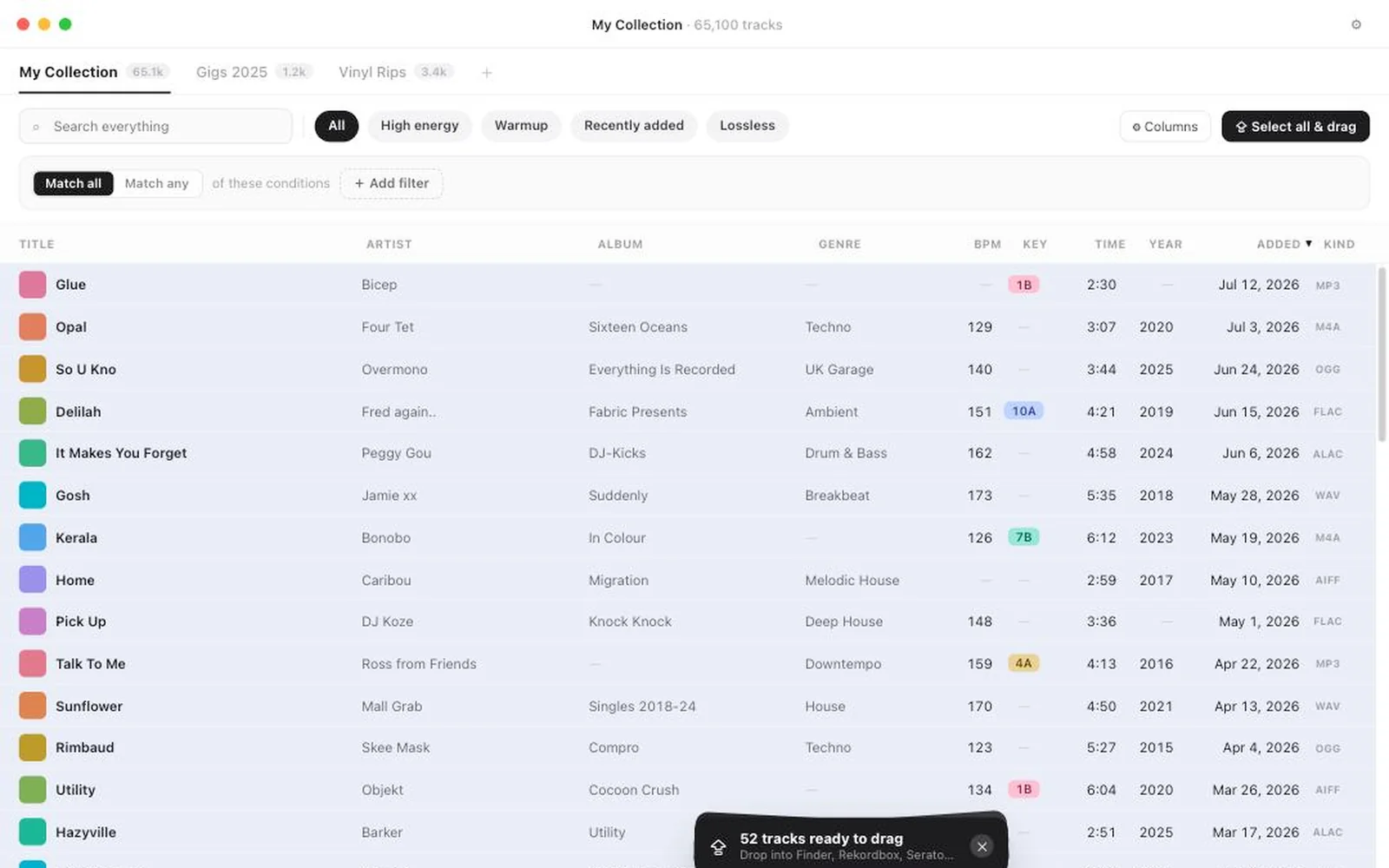
I'm learning to DJ. My library is enormous, north of 65,000 tracks and still growing, and the software I use, Serato DJ Lite, is bad at searching it by tags: artist, genre, album, whatever I'm looking for in the moment. I'd be mid-set hunting for one specific remix buried somewhere in a folder of drum and bass, typing half a title into a search box that gave me nothing back. The only tool I found that handled search well was Apple Music, and I didn't want to copy my whole collection off the flash drive it lives on just to get decent search. So I decided to see what Claude could build me instead: a standalone tool to sort and filter my library by tag, separate from Serato itself.
One prompt, an afternoon, and about $200 in API costs later, I had a real macOS app. It looked great. It was also close to unusable once you got past the demo.
That gap, between what AI can conjure in an afternoon and what actually holds up, is basically the story of my last few years as a software engineer. Let me back up.
From autocomplete to junior developer
Watching AI coding tools progress has been fascinating to me professionally. At first it was just a great way to work through individual snippets. You'd paste in what you were trying to do, it would help you tweak what you'd already written, and it got genuinely useful for thinking through larger patterns. I remember it walking me through setting up a materialized view in SQL for the first time. Took three days to fight through the hallucinations along the way, but we got there.
Now it's closer to a junior developer than an assistant. It builds full features, works autonomously for hours, deploys its own work in a browser or an emulator, looks at what came back, and iterates. It's genuinely impressive to watch.
And it's easy to mistake "impressive demo" for "cheap replacement for real software." I have clients itching to ditch their enterprise tools for something homegrown and AI-built, and I'd bet a good chunk of you reading this are thinking the same thing about your own stack. I'm not against it. But I'd caution you against assuming AI will hand you an equivalent tool, let alone a better one, for less money than what you're already paying. Tag Wrangler is a decent place to see why up close.
Tag Wrangler, in full
Before I wrote the prompt, I had to design the thing myself: library import, settings, filters, all of it. Once that was sketched out, I wrote one prompt and let it run. Three hours, $200-plus in API cost, and it looked beautiful. Even the logo took a couple of passes: an earlier lasso-shaped direction called "Coil" got cut after user testing, which in this case meant me staring at both options for a few days and picking the tag, since that's really what the app does. It hangs a tag on every track in a library this size so you can find it again.
It was also clunky in almost every way that matters once you actually try to use it. The filters were half-baked. There was no searchable dropdown for artist or album, just a plain text box. The settings screen was ugly and bare. And the big one: there was no caching, so every change ran in O(n²) time. For anyone who isn't an engineer, that means as your library grows, the app doesn't just get a little slower, it gets slower at a compounding rate. Fine for the ten-track sample I tested with. Useless for tens of thousands of tracks. With no loading state, it just looked frozen, like it had crashed rather than just gotten slow.
It took about a week of iterating after that first prompt before I was proud of it. It's called Tag Wrangler, and it's on the App Store for macOS.
Why the first prompt never gets you there
It's easy to be frustrated with the state of software. There are too many options, they've gotten expensive, they own your data, and they don't always ship the feature or the support you feel you've earned. As you try to leave, some of them make it feel like you're being held hostage right up until the last dollar's extracted. It's tempting, in that moment, to want to build your own.
Here's the challenge, though. AI is really good at building something polished and pretty. It is not good, on its own, at imagining every use case, keeping the code efficient, keeping it cheap to run, or handling every state instead of just the happy path. Tag Wrangler had all of these problems: missing error handling that would have surfaced raw, developer-facing messages to an actual user; no loading states, so it felt broken instead of busy; no thought given to what happens as the dataset scales. AI can fix every one of these. But fixing them takes time, effort, and knowing what to ask for, and none of that is free. It also costs real money: businesses are learning that AI usage is heavily subsidized right now, and paying by the token gets expensive fast once you're past a demo. Don't forget hosting costs either.
The "AI app builder" platforms don't skip this either
There's a whole category of AI-native app builders out there, and I'll say upfront that I use them about as much as I build things by hand. Here's what I've learned about them: they solve the infrastructure problem by being heavily opinionated. You'll use their SQL database. You'll use their established patterns, whether or not those patterns actually make sense for your app. They handle more of the edge cases than raw, unassisted code would, but they don't catch everything. You'll still test, you'll still iterate, and it'll still take more of your time than you planned for.
And here's the part that's easy to miss: using one of these platforms is still paying for tech. You haven't escaped software subscriptions. You've just traded your CRM bill for an AI company's bill.
What people underestimate about the timeline
The other thing people don't fully account for is time. It's true that this is nowhere near the multi-month or multi-year timelines building software used to take. It's down to weeks, genuinely. But as a business owner running your actual business, weeks is still a heavy lift for something you expect to just work. A prompt or two gets you a clunky app. It doesn't get you something that feels like the software you're used to.
When you commission software the traditional way, the developer usually follows something close to a waterfall approach. You give all the details upfront, the acceptance criteria, and ideally you've worked from first principles about what the app is actually supposed to do. They spec it out, build wireframes, design it, then build it. Named because you waterfall from step to step. You might get some visibility along the way, but typically you get the final result that checks every box you handed them.
The question worth sitting with is whether you gave them the right boxes.
Tag Wrangler is proof both directions can be true at once. One prompt got me something that looked finished and wasn't. A week of the unglamorous part, the caching, the search, the states nobody demos, is what turned it into something I'd put my name on in the App Store. AI didn't skip that week for me. It just made the week worth taking.